Tuesday, May 24, 2016

The Spanish Past Participle

A past participle is a verb that is used as an adjective.

Example:

Take the verb To Fuck.  If you were to say I'm Fucked, you have used a  verb (to fuck)  that has been reassigned as an adjective. In other words, it is a past participle

Many past participles in English are formed by adding ed at the of the verb.

The Spanish past participle is almost as easy.

Step 1

  cut off the ar er or ir ending

Step 2
Either add ada or ida depending on what kind of verb ending it has.
(ar verbs get ada. ir and er verbs get ida)

 I've likened the forming of the  Past participle  to a gender reassignment surgery so that it will be harder to forget.

First step is to  cut a few particles off  the verb.

ouch!

Second step  is to attach the new particles that will make it a past participle
You have to admit that the new ending looks a lot like "bells on a pole" which ties in nicely with my idea that forming the Past Participle is akin to a gender reassignment surgery.

FYI, Joder means to fuck.


Monday, April 11, 2016

The Irregular Verbs For The Tú Positive Command

There are 8 irregular verbs in the Spanish Tú positive command.
 
If you can remember the following mnemonic, then you can remember these 8 crazy bastards of the tú positive command.
 
 Mnemonic: SAL SAYS HE HAS TAMPONS...DIVE IN !
 
Translated ( Sal Se Ve Haz Ten Pon... Di Ven !)
 
Sal (Salir)
Sé (Ser)
Ve (Ir)
Haz (Hacer)
Ten ( Tener)
Pon (Poner)
Di (Decir)
Ven (Venir)
 

Monday, March 28, 2016

Spanish Commands

Conjugating Spanish commands is so similar to conjugating  the Spanish subjunctive that the two verb tenses look a lot like twins and in most cases, the they are.

The family relationship between the Spanish Subjunctive and Spanish Commands breaks down like this:


The Identical  Quadruplets:
The Spanish Subjunctive
The Usted Command ( both positive and negative)
The Ustedes Command ( both positive and negative)
The Tú Command ( Negative only)

These guys all are conjugated the same way ( put in yo form. Chop off the O. Add the ER present tense ending if it is an AR verb or add the AR  present tense ending if it is an ER or IR verb)
These guys all have the same irregular verbs which are Dar, Ir, Estar, Saber, and Ser.
These guy all follow the CAR GAR ZAR spelling changes.


The Fraternal Twin
The Nosotros/as commands are just like the above with the exception of one strange quirk. The positive  command for the verb  Ir is VAMOS and the negative IR command is NO VAYAMOS.

The Family Bastard
 The Tú positive command is a bastard in two important ways. First, it has a conjugation that defies logic ( conjugate by using whatever the  present usted  form  of the verb is). Then, it has 8 crazy irregular verbs.
 
Spanish Subjunctive/Spanish Command Family Tree
Spanish Commands
The Bastard  of the Family
Tú commands


Monday, February 1, 2016

The Irregular Spanish Subjunctive (Verbs With CAR GAR ZAR Endings)

You may remember when studying the past tense that verbs ending in CAR GAR or ZAR had spelling changes in the YO form.
In the Spanish subjunctive, those same spelling changes happen only in ALL the verb forms.

For verbs ending in CAR like buscar, the C changes to a QU.

busque          busquemos
busques
busque          busquen

for verbs ending in GAR like pagar, the G changes to GU.

pague          paguemos      
pagues
Pague          paguen

For verbs ending in ZAR like cruzar, the Z changes to a C

cruce           crucemos
cruces
cruce           crucen


Just like in the preterite, imagine a ZCAR in  a  CAR screaming "GARrrrr" but instead of driving through only the YO forms, he is completely out of control ( so is the subjunctive in my opinion) and he is driving through all verbs forms.

Spelling changes in the Spanish Subjunctive CAR GAR ZAR

Thursday, December 17, 2015

The Irregular Spanish Subjunctive Verbs

If you would rather die than have to learn more irregular verbs,  today is your lucky day. The first letter of the  irregular verbs of the Spanish Subjunctive happens to spell  DIES.

You will have to add an extra S to make this mnemonic work.

D ar
I r
E star
S aber
S er


Haber is also irregular in the Subjunctive but I couldn't make it fit into the death theme that I became so attached to. Besides,  you should probably know by know that haber is always doing something crazy. Just assume it is irregular unless notified otherwise.

Wednesday, November 11, 2015

How To Conjugate The Spanish Subjuctive

To conjugate the Spanish Subjunctive, you only need to follow 3 simple steps:

1.Put the verb in the Yo form of the present tense.
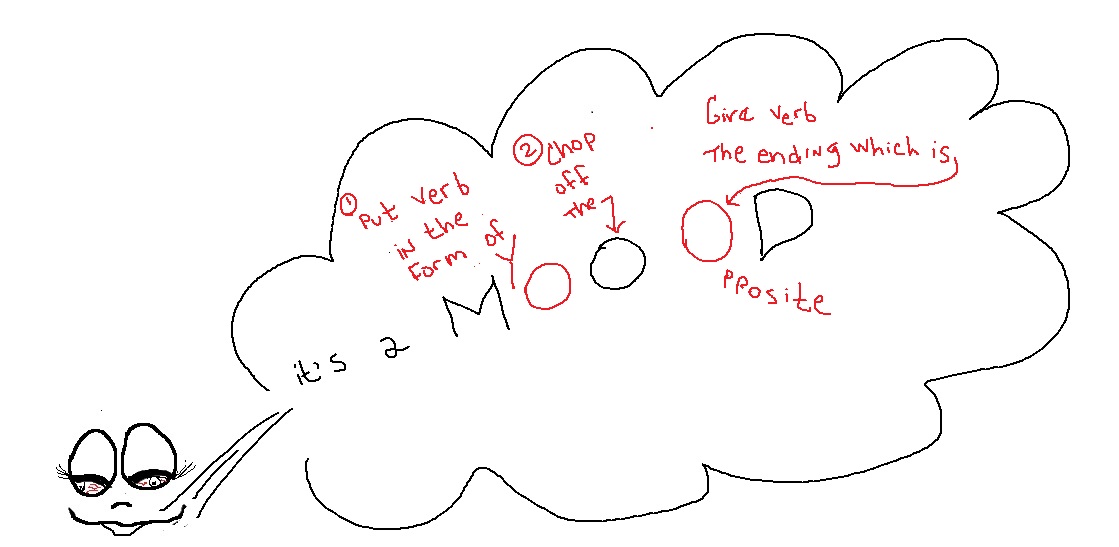
2.Chop of the O at the end.
3.Add the opposite ending ( If it is an AR verb, use the same  ER ending that is used  for the Spanish present tense. If it is an ER or IR verb, use the same ending that you would if it was an AR verb in the present tense.)

This is what it looks like in action:

Hablar
1. Hablo.... (YO)
2. Habl.... ( NO O)
3. Hable ...( Opposite)

This all becomes unforgettable because we are constantly reminded that the Spanish Subjunctive is less verb and more MOOD. Mood has enough Os to represent the 3 steps to forming this freaky verb.
Conjugate the Subjunctive in 3 easy steps

Friday, October 2, 2015

The Spanish Subjunctive


 The Spanish Subjunctive is  more of a mood than a verb. If that sounds mind-expanding, good, because the word that can help you remember when to use the Subjunctive is related to mind expansion.
The word is WEAD [pronounced weed].
 
 
Use the Spanish Subjunctive to express:
 
Wishes
Emotions
Attitudes
Desires
 
Weed and the Spanish Subjunctive
Wish: I hope that there is music.
Emotion: I am happy that the universe is infinite.
Attitude: It is good that you live in peace.
Desire: I want you to have time.


Tuesday, June 2, 2015

The Spanish Irregular Past Imperfect Verbs


There are only 3 irregular verbs in the Spanish Imperfect.
 Those 3 verbs are Ir, Ver and Ser. If that is not easy enough for you, the start of each verb spells IVS. As in those fluid-filled bags that terminate in a needle into your rubbery arm vein. You will never get a transfusion again without thinking of  this grammar rule.
The Spanish Irregular Past Imperfect Verbs
Something very irregular and imperfect is going on.Hopefully it is in your past.

Friday, April 24, 2015

Short Cut To Learning The Irregular Preterite Spanish Verbs

Remembering all of the irregular Spanish verbs in the preterite tense is not so bad if  you break it up into four steps.

Step One: the verbs that are weird all the way through ( Ser, Ir, Hacer, and Dar)

Step Two: the verbs that are only weird in the yo form ( verbs ending in car,gar or zar) and verbs that end in  a vowel after you chop of the verb ending as in Leer and Traer. Most of these guys are weird in the usted(es) form except for Traer which is weird through and through.

Step Three: The IR verbs that get weird only in the usted(es) form (Depedir, Vestire, Pedir etc.)

Step Four: The 7 stem-changers

For step one, picture the twins (Ser/Ir), the flip-flopper (Dar), and Hacer going on a vaction....
Ser/Ir:fui,fuiste,fue,fuimos,fueron
Dar: di,diste,dio,dimos,dieron
Hacer: hice,hiciste,hizo,hicimos,hiceron
For step two, They catch a ride in a car with  a zcar, who is  saying, "Garrr." and asking for someone to bring him something to read.  
Buscar: busqué (yo form)
Pagar: pagué (yo form)
Almorzar: almorcé ( yo form)
Leer: leyó/leyeron (usted and ustedes form)
Traer: traje, trajiste, trajo, trajimos, trajeron

Step Three, they all end up in a hotel called IR because this only involves verbs with IR endings. All the verbs in this category can be done in a hotel.
With this group, either an e becomes an i or u changes to an o.
Pedir: pidió/pidieron (usted and ustedes form)
Dormir: durmió/durmieron (usted and ustedes form)
Finally, and for no reason, they climb seven stairs to find the stem-changing verbs and one of the weirdos says, "Seven poo poos is cutie." Which sounds kind of random until you realize that it is a mnemonic  for saber, venir, poder, poner, estar, querer and tener...the seven stem-changing Spanish preterit verbs.
sup vin pud pus estuv quis tuve
Stem-changes for this group of freaks
Saber: sup
Venir: vin
Poder: pud
Poner: pus
Estar: estuv
Querer: quis
Tener: tuv


Wednesday, April 8, 2015

When To Use The Spanish Past Imperfect

Use  the Spanish Past Imperfect when you need a verb to talk about ongoing continuous action.

People who like to front load their stories use this type of verb. You know the kind of person who when asked, "how was your weekend?" goes into all the background information to set the scene. ("Oh my weekend, glad you asked... the sun was shining. The wind was blowing. the air was floating.")
At times this background information is relevant,  but to my ears all it sound like is BLA BLA BLA. This is helpful because bla bla bla kind of looks like the ending to the Spanish Past Imperfect endings for the AR verbs.

AR endings aba abas aba abamos aban
IR and ER endings ía ías ía íamos ían

The endings of the Ir and Er verbs sound more like (EEEEE Ya) which is the noise I am tempted to make while a run away from these big mouths.
Spanish Past Imperfect