Monday, January 19, 2015

This or That/ Esto or Eso

Esto means This. Eso means That. But there is more...
There are ending changes depending on the gender and number of whatever you are referring to.
Esto can be Esta, Este, Estos or Estas.
Eso can be Esa, Ese, Esos, or Esas.

Esto and Eso are the gender neutral versions of this and that
EXAMPLE

Esto es emocionante ( This is exciting. We do not know if it is male or female...just exciting. so use the gender neutral esto.)

Eso es inteligente ( That is intelligent. Again, use neutral, because we do not know what is intelligent.)

It is easy to get Esto and Eso mixed up so I find it best to think like this:

Esto means this which is closer to me than that. Esto  has a T in it. T stands for Touch. If  this is close to me I can touch it.

Eso means that- which rhymes with splat. And eso and all of it's variations (plural and gender) look like little splats. See for yourself...
How to remember the difference between eso and esto
easy way to remember esto vs eso


Tuesday, January 6, 2015

Spanish Reflexive Verbs

In Spanish,  a  reflexive verb is a verb that you do to yourself. Reflexive verbs are easy to find because of three reasons...
Reason #1:  They have SE tacked on to the end of the verb (bañarse, ducharse, maquillarse)
Reason #2: A lot of the reflexive verbs are done in the bathroom ( bañarse means to bathe oneself. Ducharse means to shower owneself. Maquillarse means to put makeup on oneself.)
Reason# 3: A lot of the reflexive verbs are done in the bedroom ( dormirse means to go to sleep. leventarse means to get out of bed.)

When you conjugate a reflexive verb, the se part changes to its appropriate pronoun (me, te, se, nos, se)


Even though the se part is at the end of the verb, when you conjugate it, you put the  reflexive part in front of the conjugated verb. (me baño means I wash myself)


To keep reflexive verbs lined up, I think like this:
Reflexive Verb should make you think of an RV. Often times RVs have little trailers. So this is what I picture when I think of Reflexive Verbs

An easy way to remember Spanish reflexive verbs
When you conjugate the reflexive verb just imagine stopping the RV,  unloading the trailer and putting  the pronouns in front of the RV. By the way, the driver is saying that he scratches  himself.

Thursday, December 18, 2014

The Present Progressive

The Present Progressive is the verb tense you use when you want to say what you are doing.
If the verb ends in  ING, it's a fair bet that it is in the Present Progressive Tense.

The Spanish Present Progressive Formula:

Estar ( correctly conjugated to agree with subject)
                                  +
 The Verb ( with an "ando" or "iendo" added to the end)

Example: Estoy comiendo ( I am eating)


To remember this rule think of two twins Andy and Ion  ( ando and iendo). These two boys are so ADD that they are always doing things.


Examples of the present progressive
Ion is saying: I am moving. We are running
Andy is saying: we are yelling. My knee is bleeding.

iendo ending is for IR verbs/ ando ending is for AR verbs.

Friday, December 5, 2014

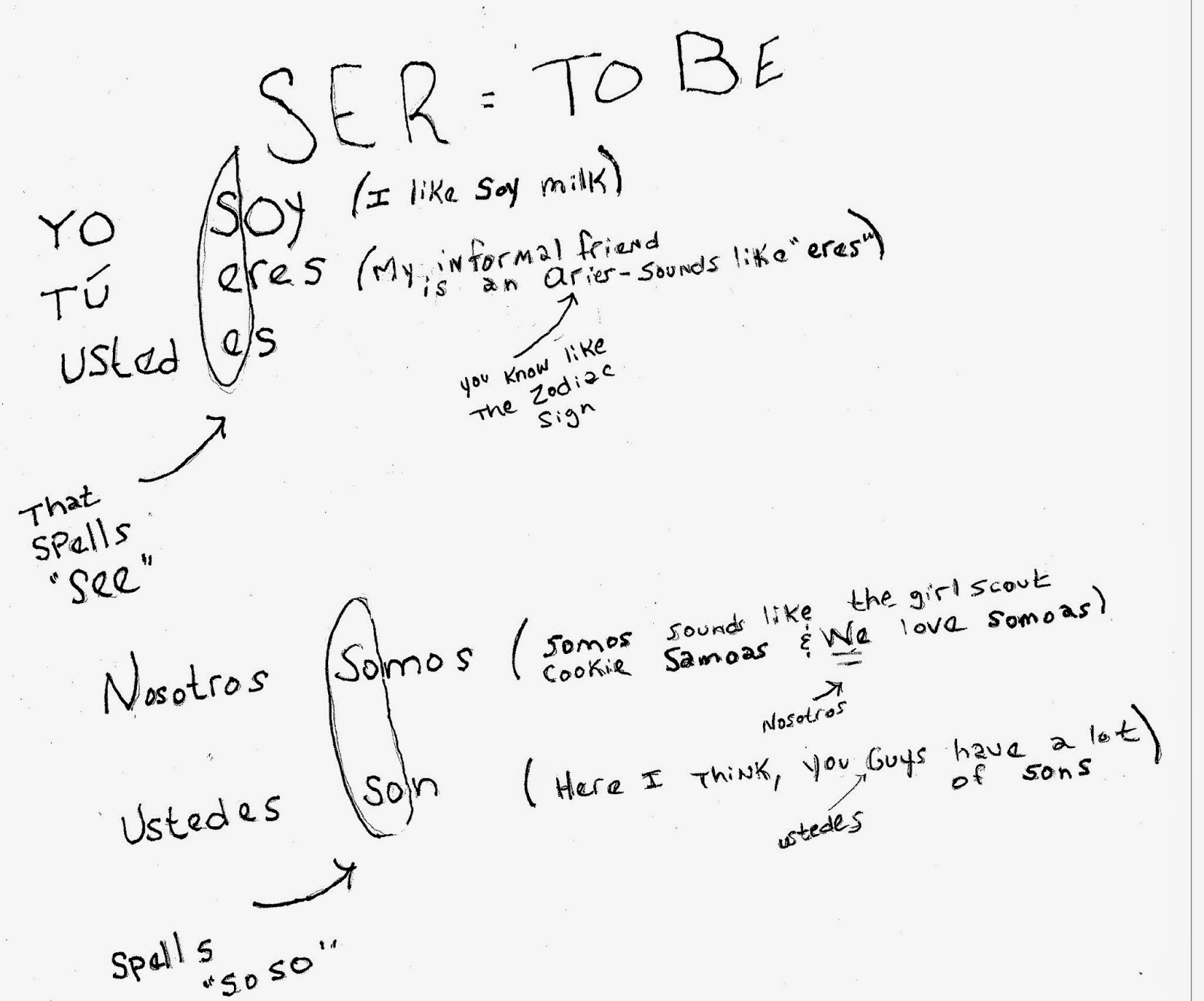
The Verb SER

The verb ser means to be and it has a conjugation that defies logic as you can see below:

yo         soy                         nosotros    somos
tú         eres  
usted    es                            ustedes     son


Below are my doodles that help me remember this conjugation:
and easier way to remember how to conjugate SER
Add caption

Friday, November 21, 2014

Spanish Direct and Indirect Object Pronouns

 More than half of the Spanish Direct Object Pronouns  look like the Spanish Indirect Object Pronouns

As you can see here:

DO Pronouns: me  te   lo/la   nos   los/las
IO   Pronouns: me  te   le        nos   les


The DO pronouns have a male/female distinction in the third person singular and third person plural.

The IO  pronouns use the gender neutral Le and Les for the third person.

I can make you remember this without a disturbing drawing.


Because the Independent Object is so independent, it uses LESs pronouns
How cool is that?


Thursday, November 13, 2014

Indirect Objects

The Indirect Object is the noun to whom the Direct Object is being given or told.

For example: I gave the pizza to the pirate. 

Pizza is the Direct object because it answers the question "Who or what did I give?"
The Pirate is the Indirect Object because it answers the question, " to whom did I give the Direct Object ( the pizza) ?"

The Indirect Object is also known as IO.
And if you look closely, IO looks like sideways pair of pirate boots and a pizza. And pirates ask questions like to whom or to what. At least the ones I personally know do!

I prove my point about pirates asking to whom and that IO looks like a pirate's boots next to a pizza with this illustration...


Indirect Object and pirate Jack Sparrow
See, pirates do ask, "to whom". The IO is in the lower right hand corner.

To find the DO,  ask  "who or what "
to find the IO,  ask "to who"  or "for what"

Thursday, November 6, 2014

Direct Objects

If you have to pass a first year Spanish class or a 7th grade English class, you will have to learn what a Direct Object is.

A Direct Object is the noun in the sentence that is getting verbed.

For example: The owl eats veggie burgers.

find the verb ( eats ) and ask, "who or what  is getting verbed ( or in this case eaten) ?
The answer  ( and the direct object ) is veggie burgers.

Sometimes a Direct Object is called a DO for short. The letters DO look like owl eyes and owls make noises that sound like "hoo hoo" which  sounds like  "who?  who?" which is what you ask yourself when you are trying to find the Direct Object. 
Direct Object
 To find the DO, ask yourself hoo or what is being verbed.

Wednesday, October 29, 2014

Acabar + De + Verb = Easy Past Tense

To talk about the past without knowing how to conjugate the Spanish past tense, you can use the verb ACABAR ( to have just)

This can be done in 3 simple steps:

(1) Acabar (in conjugated form)

+
(2) De

+

(3) Verb (in infinitive form)


Example: Acabo de vomitar ( I just threw up)

To make an unforgettable image, picture that you made an "ack" sound at a bar (acabar).
I think it might look something like this:

Acabar de infinitive verb


\

Thursday, October 23, 2014

Ir + A + Infinitive = Packing For The Future

 In Spanish,you do not have to learn a whole new conjugation to talk about the future.
Instead you can talk about the future in three steps.

                                                                     1. Ir
                                                                     2 A
                                                                     3 Infinitive form of verb

Example: Voy a comer ( I am going to eat)

To remember these three steps,
think about packing for future trip and you only need to pack three things:

1. a to go (Ir) bag
2. the letter A
3. the verb

IR plus A plus the infinitive
Imagine packing your bags for the future and these are the only 3 things that you need.

Wednesday, October 15, 2014

Introductions in Spanish


Sorry introverts.
Whether you are taking a Spanish class in a real school or you are taking a just- for- fun version, all Spanish teachers are the same in that you will have to introduce everyone in the class to each other. 

Just say this, "Quiero presentarte a (name of person you are introducing )" (informal version)
or
"Quiero presentarle a ( name of person you are introducing)" ( formal version)

It is a 5-step process

1 Quiero ( I want )
2 Presentar ( to present)
3 Te or Le ( to you)
4 A  (this is the personal A. It means nothing to English speakers)
5 Name of person that you are introducing

5 steps means that you can write each one on a finger


Spanish introductions
Easy to read when you are shaking hands